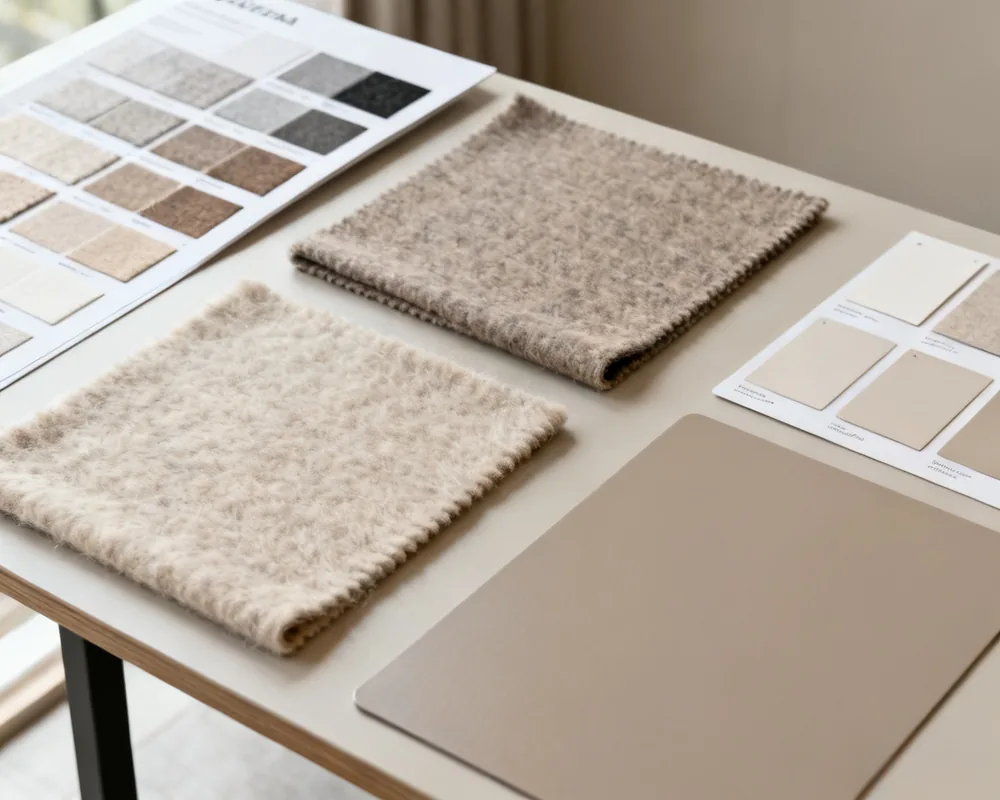
Start with the seat, the panel, or the banquette, then put a physical cutting next to that description.
Fabric selection guide
Begin with the setting
Describe the furniture and the housekeeping before you narrow Maharam fabrics. A lounge chair that is vacuumed, a banquette that is wiped after service, and a wall panel that is dusted rather than wiped push the shortlist in different directions. Daily contact, the cleaning chemistry, moisture from spills, and the way pieces will be cut all change the conversation. Asking for a single winner is less useful than saying which of those pressures is fixed by the project. Several constructions can look related on a screen and still part company once the cutting is in the hand.
Fabric selection guide — compare at least four dimensions
Dimension
Review question
Evidence or next step
Touch
A fibre name does not settle hand or drape
Review the physical cutting and the weave, knit, or coating
Care
The housekeeping method can rule a face in or out
Describe the actual cleaner, the dwell, and who maintains the room
Exposure
Spills, abrasion, and light each need their own note
Separate liquid cleaning, wear method, and the lamps in the room
Processing
Seams, repeats, and grain direction change yield
Discuss usable width, check scale, and how edges will be joined
Handle the sample as information
Photographs help a team remember a wool check or a coated grain, but they flatten thickness and sheen. A physical cutting shows drape over an arm, the nap direction, and whether a vinyl face creases at the radius you need. Write the intended construction and finish on the same card as the cutting so the comparison answers one question. If the standard is an older memo, date it. Screen colour from a product page is only a pointer toward that card.
Compare the construction, not one label
Composition and GSM are necessary fields and still incomplete. Yarn, weave, a knit structure, or a coating weight can move hand and seam behaviour while the nominal mass stays still. Read a maharam upholstery fabric note and a maharam vinyl note as two systems. When wear, pilling, or tear matters to the seat, ask for the method and the specimen condition instead of borrowing a figure from a neighbouring quality. Lightfastness under the project glazing is its own line, separate from abrasion.
Prepare a shortlist with tradeoffs
More than one route can be plausible. Rank care, hand, width, and shade stability for the actual room, then state what the next cutting must clarify. A coated face may win on wiping and lose on the tactile brief. A wool check may win on character and need a narrower shade band than the schedule allows. An explicit tradeoff gives the inquiry something to answer. It does not invent a universal winner, a stock confirmation, or a certificate for every colourway.
Stock continuity and a custom route
Stock selection starts from a named reference, then asks what the current lot, shade band, and replenishment note actually say. A date on the memo matters. Custom development starts from a target construction and keeps sample, trial, and bulk approval as separate gates. A change after the trial is a new approval. Minimum order and development timing are confirmed in a reply if they are known. They are not stated on this page.
Keep the specification units visible while that choice is open. Mass is recorded in g/m², usable width in centimetres apart from the selvedge, and composition as percent by mass summing to 100. Yarn linear density stays in dtex or denier when a sheet already uses one of those units. A dining banquette brief might carry worksheet targets of 320 g/m² and 140 cm, marked as targets, next to a cutting dated on the card. The repeatable check is to view that cutting under the room lamps, name the cleaner and dwell, and copy any method plus specimen state already on a sheet. Unknown certificate numbers, unknown plant capacity, and unknown founding year stay blank.
Use this page to prepare a question, not to supply a measured result. Write the known material reference first, then the decision that is still open. Method, specimen and scope stay attached to any figure that is already in hand. Unknown points stay questions.
Notes to keep with the page
Note
Write this
Leave this open
Material
Composition, construction and finish if known
Any value that has not been confirmed
Decision
The comparison or approval the inquiry needs
A conclusion the record does not support
Evidence
Method, specimen and scope when a report exists
A label used without that context
Next step
The sample or document that would resolve the question